How to Prepare for the Next Crypto Bull Run: A Data-Driven Strategy
To prepare for the next crypto bull run, accumulate during the bear market using dollar-cost averaging, diversify across risk tiers, and use a systematic exit strategy like sell-half-on-a-double to lock in profits while keeping upside exposure.
Every Bitcoin cycle follows the same pattern: accumulation during the bear market, breakout after the halving, euphoria at the top, and a crash that wipes out those who bought late and held too long. If you understand this pattern, you can position yourself before the move happens.
This guide covers the mechanics of crypto market cycles, how to build positions during accumulation phases, when to take profits, and how to avoid the mistakes that turn paper gains into real losses.
Understanding Bull and Bear Markets in Crypto
What Is a Crypto Bear Market?
A bear market is a prolonged period of declining prices. In crypto, bear markets are more severe than in stocks. Typical crypto bear market declines:
| Cycle | Peak | Trough | Decline | Duration |
|---|---|---|---|---|
| 2013-2015 | ~$1,150 | ~$170 | -85% | ~14 months |
| 2017-2018 | ~$19,700 | ~$3,200 | -84% | ~12 months |
| 2021-2022 | ~$69,000 | ~$15,500 | -77% | ~13 months |
Bear markets are characterized by widespread pessimism, declining trading volume, and most altcoins losing 90-99% of their value. They are also the best time to accumulate.
What Is a Crypto Bull Run?
A bull run is a sustained period of rapidly rising prices. In crypto, bull runs typically last 12-18 months and deliver returns that dwarf any other asset class:
| Cycle | Trough | Peak | Gain | Duration |
|---|---|---|---|---|
| 2015-2017 | ~$170 | ~$19,700 | +11,488% | ~24 months |
| 2018-2021 | ~$3,200 | ~$69,000 | +2,056% | ~36 months |
| 2022-present | ~$15,500 | In progress | TBD | Ongoing |
The key insight: bull runs reward those who accumulated during the bear market, not those who buy during the euphoria.
The Bitcoin 4-Year Cycle: Your Timing Framework
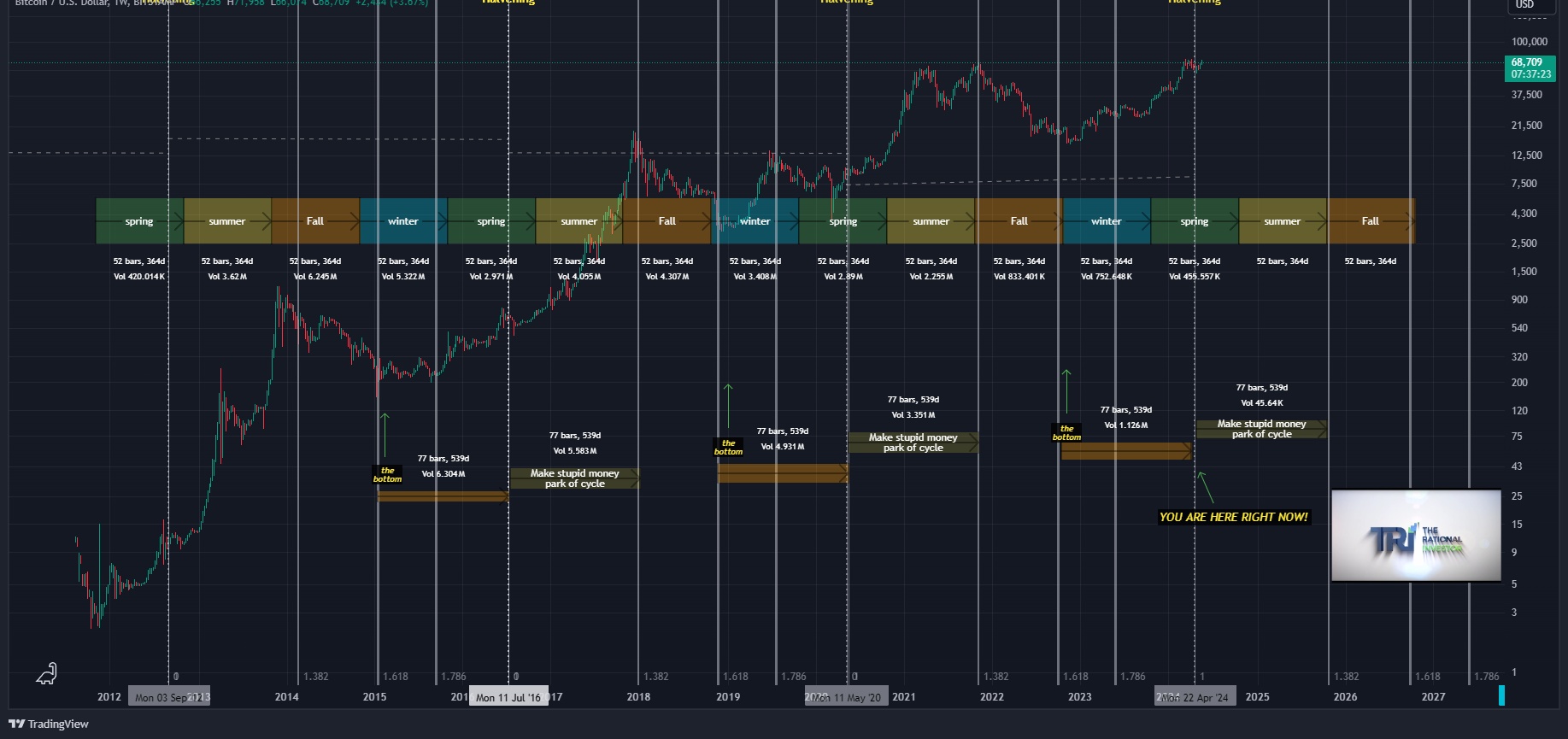
Bitcoin’s price follows a roughly 4-year cycle driven by the halving, an event that cuts the mining reward in half approximately every four years. This reduces new supply entering the market and has historically preceded major price increases.
| Event | Cycle 2 | Cycle 3 | Cycle 4 |
|---|---|---|---|
| Halving date | July 2016 | May 2020 | April 2024 |
| Months to cycle peak | ~17 months | ~18 months | TBD |
| Peak price | ~$19,700 | ~$69,000 | In progress |
| Months from peak to trough | ~12 months | ~13 months | TBD |
| Trough decline | -84% | -77% | TBD |
Where Are We Now? (March 2026)
We are approximately 23 months past the April 2024 halving. Previous cycles peaked 17-18 months post-halving, which would have placed the Cycle 4 peak around September-October 2025. However, this cycle has differed from previous ones in several ways:
- Bitcoin ETF demand (approved January 2024) created a new, sustained source of buying pressure
- Institutional adoption has dampened volatility compared to previous cycles
- Macro conditions (interest rates, global liquidity) have influenced timing
For a complete analysis of all four halving cycles with detailed data: The Bitcoin Halving Cycle: History, Data, and What Comes Next.
The cycle framework is not a crystal ball. It is a probabilistic guide that helps you understand where you likely are in the broader market structure.
The Accumulation Strategy: Building Positions Before the Bull Run
The most profitable approach to crypto is not buying during the rally. It is accumulating during the boring, low-volatility periods that precede it.
Phase 1: Identify the Accumulation Zone
Accumulation zones typically occur 12-24 months after a cycle peak, when:
- Mainstream media has stopped covering crypto
- Trading volume is at multi-year lows
- Social media sentiment is overwhelmingly bearish
- Altcoins have fallen 80-95% from their highs
- Bitcoin is trading below its previous cycle high
Phase 2: Dollar-Cost Average into Core Positions
During accumulation, use dollar-cost averaging (DCA) to build your core position. This removes the pressure of timing the exact bottom.
| DCA Strategy | Weekly Amount | 12-Month Total | Best For |
|---|---|---|---|
| Conservative | $25-$50 | $1,300-$2,600 | First-time investors |
| Moderate | $50-$100 | $2,600-$5,200 | Experienced investors |
| Aggressive | $100-$250 | $5,200-$13,000 | High-conviction, high-income |
Allocation during accumulation:
- 60-70% Bitcoin
- 20-30% Ethereum
- 0-10% Selected altcoins (only tokens with real utility and active development)
Phase 3: Tactical Buys at Key Levels
In addition to regular DCA, you can make larger purchases at key technical levels:
- Previous cycle highs acting as support
- 200-week moving average (historically a strong buy zone for Bitcoin)
- Major Fibonacci retracement levels (61.8%, 78.6% from previous high)
- Extreme fear readings on the Crypto Fear and Greed Index (below 20)
These tactical buys are optional. DCA alone will give you solid positioning if you start early enough in the cycle.
The Sell-Half-on-a-Double Strategy
One of the most effective risk management techniques in crypto is the “sell half on a double” (SHOD) approach. It is simple, mechanical, and removes emotion from profit-taking.
How It Works
- Buy an asset at a given price (e.g., $1,000 worth of a token at $10)
- When it doubles to $20, sell half your position (sell $1,000 worth)
- You now have a “free position” - your original investment is recovered, and the remaining tokens cost you nothing
- Let the free position ride - it can go to 5x, 10x, or zero. Your risk is zero.
- If it doubles again, sell half of the remaining position. Repeat.
Example: SHOD in Practice
| Step | Action | Position Size | Cash Recovered | Cost Basis of Remainder |
|---|---|---|---|---|
| Buy | Purchase $1,000 at $10 per token | 100 tokens | $0 | $10/token |
| 1st Double ($20) | Sell 50 tokens for $1,000 | 50 tokens | $1,000 (original back) | $0 (free position) |
| 2nd Double ($40) | Sell 25 tokens for $1,000 | 25 tokens | $2,000 total | $0 (still free) |
| 3rd Double ($80) | Sell 12.5 tokens for $1,000 | 12.5 tokens | $3,000 total | $0 (still free) |
After three doubles, you have recovered $3,000 on a $1,000 investment and still hold 12.5 tokens worth $1,000. If the token crashes to zero, you still made $2,000 profit. If it continues to rise, you still have exposure.
Why SHOD Works Psychologically
Most traders fail at taking profits because:
- They feel like they are “selling too early” if the price keeps rising
- They hold through the entire bull run and the entire crash, ending with nothing
- They set arbitrary price targets that may or may not be hit
SHOD removes all of this. The rule is mechanical: it doubled, sell half. No analysis needed, no FOMO, no “what if it goes higher.” You systematically de-risk while maintaining upside exposure.
Applying SHOD to a Crypto Portfolio
| Position Type | When to Apply SHOD | Notes |
|---|---|---|
| Bitcoin | Optional - many prefer to hold BTC long-term | Can apply SHOD to BTC bought at cycle lows |
| Ethereum | Recommended | ETH cycles are more volatile than BTC |
| Large-cap altcoins | Strongly recommended | SOL, AVAX, LINK, etc. are cyclical |
| Small-cap altcoins | Mandatory | These can 10x and then go to zero |
When to Be Cautious: Recognizing Cycle Tops
Knowing when to start taking profits is just as important as knowing when to buy. Cycle tops share common characteristics:
Warning Signs of a Cycle Top
| Indicator | What It Looks Like |
|---|---|
| Mainstream media coverage | ”Bitcoin is going to $1 million” headlines on CNN, CNBC daily |
| Celebrity endorsements | Athletes, actors, influencers launching tokens |
| Your non-crypto friends asking | ”Should I buy Bitcoin?” from people who have never mentioned crypto |
| Extreme greed readings | Crypto Fear and Greed Index above 90 for extended periods |
| Diminishing returns on altcoins | New tokens pumping hard but previous leaders stagnating |
| Leverage everywhere | Funding rates consistently positive, everyone is long |
| ”This time is different” | Widespread belief that the cycle will not end |
No single indicator calls the top. But when multiple indicators align, it is time to increase your profit-taking pace, not your buying.
Profit-Taking Schedule
A mechanical profit-taking schedule removes emotion:
| Portfolio Value vs. Cost Basis | Action |
|---|---|
| 2x original investment | Sell 25% of altcoin positions (recover some capital) |
| 3x original investment | Sell 25% more (you have now recovered 50%+ of capital) |
| 5x original investment | Sell 25% more (you are now playing with house money) |
| 10x or top signals appearing | Sell remaining altcoins, hold only BTC/ETH core |
Common Bull Run Mistakes
| Mistake | Why It Costs You | How to Avoid It |
|---|---|---|
| Buying at the top | FOMO after 300%+ rally | Accumulate during the bear, not the mania |
| Never taking profits | ”It will go higher” | Use SHOD or a mechanical profit schedule |
| Going all-in on altcoins | Altcoins crash 90-99% in bear markets | Keep 60-70% in BTC/ETH core |
| Using leverage in a bull market | ”Free money” until the 30% correction | Avoid leverage entirely, or max 2x |
| Ignoring the cycle | Assuming the rally will last forever | Study the 4-year cycle; have an exit plan |
| Holding through the entire bear | Watching 5x gains turn to -50% | Start selling when top signals appear |
| Trading too frequently | Fees, taxes, emotional decisions | DCA in, SHOD out. Do not overtrade. |
Your Bull Run Preparation Checklist
Use this checklist to assess your readiness:
| Step | Action | Status |
|---|---|---|
| 1 | Opened an account on a regulated exchange (Coinbase, Kraken, Gemini) | |
| 2 | Enabled 2FA with an authenticator app (not SMS) | |
| 3 | Started a DCA schedule into BTC (and optionally ETH) | |
| 4 | Set up a hardware wallet for long-term holdings over $5K-$10K | |
| 5 | Defined my total crypto allocation as a % of investable assets | |
| 6 | Written exit rules (SHOD levels, profit-taking schedule, or both) | |
| 7 | Studied the Bitcoin 4-year cycle and know where we are | |
| 8 | Have a plan for altcoin exposure (which tokens, max allocation per token) | |
| 9 | Set up crypto tax tracking software from day one | |
| 10 | Joined a community for market updates and accountability |
Frequently Asked Questions
When is the next crypto bull run?
Crypto bull runs have historically followed the Bitcoin halving by 12-18 months. The most recent halving occurred in April 2024. As of March 2026, we are 23 months past the halving. Whether the bull run has peaked, is ongoing, or has a second leg depends on multiple factors including macro liquidity, ETF flows, and global economic conditions. See our Bitcoin halving cycle analysis for detailed data.
How much should I invest in crypto before a bull run?
Only invest money you can afford to lose entirely. A reasonable allocation for most people is 5-10% of investable assets. During accumulation phases, DCA a fixed weekly amount ($25-$250 depending on income) into Bitcoin and Ethereum. Never invest emergency funds, rent money, or borrowed capital.
Should I buy altcoins or just Bitcoin?
During accumulation, focus 60-70% on Bitcoin and 20-30% on Ethereum. Altcoins can deliver outsized returns but also lose 90-99% of their value in bear markets. If you add altcoin exposure, limit any single position to 5% of your crypto portfolio and only choose tokens with real utility, active development teams, and proven track records.
What is the best strategy for taking profits during a bull run?
The sell-half-on-a-double (SHOD) strategy is one of the simplest and most effective approaches. When any position doubles from your entry, sell half to recover your original investment. The remaining tokens are a “free position” with zero risk. Combined with a mechanical profit-taking schedule based on portfolio value, this approach ensures you lock in gains while maintaining upside exposure.
How do I know when the bull run is over?
No one can call the exact top. But cycle tops share common characteristics: mainstream media euphoria, celebrity token launches, your non-crypto friends asking about Bitcoin, extreme greed readings, and widespread belief that “this time is different.” When multiple top indicators align, increase your profit-taking pace.
Can I still make money if I missed the bottom?
Yes. You do not need to buy the exact bottom to profit from a bull run. Dollar-cost averaging works at any point in the accumulation phase. The key is having a plan: defined entry strategy, position sizing rules, and an exit strategy before the euphoria takes over. The traders who lose money are those who buy during the mania without a plan, not those who bought slightly above the bottom.
Next Steps
- Understand the Bitcoin cycle so you know where we are: The Bitcoin Halving Cycle: History, Data, and What Comes Next
- Learn broader market cycles that influence crypto: 10 Market Cycles Every Trader Should Know
- Build a trading plan with written entry and exit rules: How to Make a Trading Plan
- Start with the basics if you are new to crypto: How to Start Investing in Crypto
This guide is for educational purposes only. Cryptocurrency is a highly volatile asset class. Past performance does not guarantee future results. Never invest money you cannot afford to lose.
Ready to trade with an edge?
Join TRI for daily macro briefs, scanner recaps, and a community of serious traders.