How to Start Investing in Crypto: A Beginner's Guide for 2026
To start investing in crypto, choose a regulated exchange, set up secure storage, start with Bitcoin and Ethereum, use dollar-cost averaging to build positions, and never invest more than you can afford to lose.
Crypto volatility dwarfs the stock market: a 10-20% drawdown in a single week is normal, not exceptional. Without a plan, most beginners buy at the top, panic sell at the bottom, and swear off crypto forever.
This guide covers how to actually buy crypto, how to store it safely, how to size your positions, and how the Bitcoin 4-year cycle affects your timing.
Crypto vs. Stocks: Why the Rules Are Different
If you have experience with stocks, some of that knowledge transfers. Risk management and position sizing still matter. But crypto has unique characteristics that change how you should approach it.
| Factor | Stocks | Crypto |
|---|---|---|
| Market hours | Mon-Fri, 9:30am-4pm ET | 24/7, 365 days per year |
| Regulation | SEC-regulated, SIPC-insured (up to $500K) | Varies by country; limited investor protection |
| Daily volatility | 1-3% moves typical | 5-15% moves common; 30%+ in extreme events |
| Custody | Broker holds shares (insured) | You can self-custody or trust an exchange |
| Fundamental analysis | Earnings, revenue, P/E ratios | On-chain data, tokenomics, developer activity |
| Market maturity | 200+ years of data | ~15 years of data for Bitcoin; less for altcoins |
| Leverage availability | Limited, regulated | Widely available (up to 100x on some platforms) |
| Tax reporting | Automated 1099 from broker | Often manual; varies by jurisdiction |
The biggest difference for beginners: crypto has no circuit breakers, no market close, and limited regulatory protection. The market does not pause when prices drop 20%. You need to manage your risk because no one else will.
Step 1: Choose an Exchange
An exchange is where you buy, sell, and (optionally) store cryptocurrency. The exchange you choose matters for security, fees, and available assets.
| Exchange | Best For | Supported Assets | Fees | Key Feature |
|---|---|---|---|---|
| Coinbase | Beginners | 250+ tokens | 0.4-0.6% maker/taker | Simplest interface, strong US regulation |
| Kraken | Intermediate | 200+ tokens | 0.16-0.26% maker/taker | Lower fees, good security track record |
| Interactive Brokers | Stock traders adding crypto | BTC, ETH, LTC, BCH | 0.12-0.18% | Unified stock + crypto account |
| Gemini | Security-focused | 100+ tokens | 0.2-0.4% maker/taker | SOC 2 certified, insurance on custodial assets |
What to look for:
- Regulatory compliance in your country (licensed, insured where possible)
- Two-factor authentication (2FA) support (mandatory; use an authenticator app, not SMS)
- Withdrawal whitelist option (only allows withdrawals to pre-approved addresses)
- Fee structure that matches your trading frequency
What to avoid:
- Offshore exchanges with no regulatory oversight
- Any exchange that does not support 2FA
- Platforms offering 50-100x leverage to new accounts
Step 2: Understand Custody (Where Your Crypto Lives)
When you buy crypto on an exchange, the exchange holds it for you. This is called custodial storage. You can also move crypto to your own wallet for self-custody.
| Custody Type | How It Works | Best For | Risk |
|---|---|---|---|
| Exchange (custodial) | Exchange holds your keys | Beginners, active traders | Exchange hack, insolvency |
| Hardware wallet (self-custody) | Physical device stores your keys offline | Long-term holders ($5K+) | Losing the device or seed phrase |
| Software wallet (self-custody) | App on your phone or computer | Intermediate users | Malware, phone compromise |
For beginners: Keep your crypto on a reputable exchange (Coinbase, Kraken, Gemini) until your holdings exceed $5,000-$10,000. At that point, consider a hardware wallet (Ledger or Trezor) for long-term holdings. Keep only what you are actively trading on the exchange.
Critical rule: If you use self-custody, your seed phrase (12 or 24 words) is everything. Write it on paper. Store it in a safe. Never store it digitally (no photos, no cloud storage, no notes apps). If you lose your seed phrase and your device breaks, your crypto is gone permanently.
Step 3: Start with Bitcoin and Ethereum
With thousands of tokens available, beginners face overwhelming choice. Start simple.
| Asset | What It Is | Market Position | Beginner Allocation |
|---|---|---|---|
| Bitcoin (BTC) | Digital store of value, fixed supply of 21 million | Largest by market cap (~55-60% dominance) | 50-70% of crypto portfolio |
| Ethereum (ETH) | Programmable blockchain, hosts most DeFi and NFT activity | Second largest by market cap | 20-30% of crypto portfolio |
| Altcoins | Everything else (SOL, AVAX, LINK, etc.) | Varies widely; most lose value over 4+ years | 0-20% (only after 6+ months of experience) |
Why this allocation:
- Bitcoin has the longest track record, highest liquidity, and has recovered from every major crash in its 15-year history
- Ethereum is the infrastructure layer for most of decentralized finance
- Altcoins can deliver outsized returns but also frequently go to zero. Do not touch them until you understand the market cycle
Rule of thumb: If you cannot explain what a token does in one sentence, do not buy it.
Step 4: Size Your Position (How Much to Invest)
Crypto should be a portion of your overall investment portfolio, not your entire net worth.
| Experience Level | Suggested Crypto Allocation | Position Sizing |
|---|---|---|
| Complete beginner | 1-5% of investable assets | Fixed dollar amount monthly (DCA) |
| Some trading experience | 5-10% of investable assets | DCA + tactical buys at key levels |
| Experienced trader | 10-20% of investable assets | Active trading with defined risk per trade |
Dollar-cost averaging (DCA) is the simplest and most effective strategy for beginners. Pick a fixed dollar amount ($50, $100, $500) and buy the same amount of Bitcoin every week or month regardless of price.
Why DCA works:
- Removes the pressure of “timing the market”
- Automatically buys more when prices are low and less when prices are high
- Turns volatility from an enemy into an advantage
- Requires zero technical analysis knowledge
| DCA Amount | Frequency | Annual Investment | What It Builds |
|---|---|---|---|
| $25/week | Weekly | $1,300/year | Entry-level exposure |
| $50/week | Weekly | $2,600/year | Meaningful position over 2-3 years |
| $100/week | Weekly | $5,200/year | Significant allocation |
| $500/month | Monthly | $6,000/year | Substantial crypto portfolio |
Never invest money you cannot afford to lose. Crypto can and does drop 50-80% during bear markets. Your DCA contributions should come from discretionary income, not rent money or emergency funds.
Step 5: Understand the Bitcoin 4-Year Cycle
Bitcoin follows a roughly 4-year cycle driven by the halving event, where the mining reward is cut in half approximately every 4 years. This reduces new supply and has historically preceded major bull runs.
| Cycle | Halving Date | Cycle Low | Cycle High | Low-to-High Return |
|---|---|---|---|---|
| Cycle 1 | Nov 2012 | ~$2 | ~$1,150 | +57,400% |
| Cycle 2 | Jul 2016 | ~$200 | ~$19,700 | +9,750% |
| Cycle 3 | May 2020 | ~$3,800 | ~$69,000 | +1,715% |
| Cycle 4 | Apr 2024 | ~$15,500 | In progress (2026) | TBD |
Key pattern: Each cycle delivers diminishing but still significant returns. The drawdowns are also severe: Bitcoin dropped 85% from its 2017 high, 77% from its 2021 high, and similar corrections are expected in future cycles.
Where are we now (March 2026)? We are roughly 23 months past the April 2024 halving. Historically, cycle peaks occur 12-18 months after the halving, though Cycle 4 has followed a different pattern with Bitcoin ETF demand changing the supply/demand dynamics.
For a deep dive into how the halving cycle works and what it means for your investment timing, see: The Bitcoin Halving Cycle: History, Data, and What Comes Next.
Step 6: Manage Your Risk
Crypto’s volatility makes risk management even more important than in stocks. Here are the rules:
Position Sizing Rules
| Rule | Application |
|---|---|
| Total crypto allocation | Never more than 5-20% of your investable assets |
| Single altcoin position | Never more than 5% of your crypto portfolio in one altcoin |
| Leverage | Avoid entirely as a beginner; if used later, never exceed 2x |
| Stop losses on active trades | Mandatory if swing trading; set before entering the trade |
| DCA contributions | Fixed amount from discretionary income only |
When to Sell
Most beginners have no sell plan. They ride gains up and ride them all the way back down. Here are three legitimate sell strategies:
- Target-based selling: Set a price target before buying. When it hits, sell a portion (25-50%) regardless of momentum.
- Time-based selling: Sell a portion at predetermined dates (e.g., 12 months after halving, 18 months after halving).
- Rebalancing: When crypto exceeds your target allocation (e.g., grows from 10% to 25% of portfolio), sell enough to rebalance back to 10%.
The worst strategy is having no strategy. Decide when you will take profits before the market forces the decision on you.
Common Crypto Mistakes (and How to Avoid Them)
| Mistake | Why It Happens | How to Fix It |
|---|---|---|
| Buying at the top | FOMO from social media hype | Use DCA to remove timing pressure |
| Holding through a 70% drawdown | No sell plan, “it will come back” | Set exit rules before buying |
| Putting everything in altcoins | Chasing 100x returns | Keep 50-70% in BTC, 20-30% in ETH |
| Using high leverage | ”Free money” illusion | Avoid leverage entirely for 12+ months |
| Storing crypto insecurely | Laziness, ignorance of risks | Enable 2FA immediately, hardware wallet for large amounts |
| Trading 24/7 | Market never closes, feels like missing out | Set specific review times (once or twice per day) |
| Ignoring taxes | Complexity, “no one tracks this” | Track every trade from day one; use crypto tax software |
| Buying tokens you cannot explain | Influencer hype, FOMO | If you cannot explain it in one sentence, skip it |
Frequently Asked Questions
How much money do I need to start investing in crypto?
Most exchanges allow purchases from $10-$25. A reasonable starting point for DCA is $25-$50 per week. The amount matters less than building the habit and learning how the market behaves through an actual position.
Is crypto a good investment in 2026?
Crypto is a volatile, asymmetric asset class. It has produced some of the highest returns in financial history, but also some of the largest drawdowns (50-85%). Whether it is “good” depends on your risk tolerance, time horizon, and portfolio allocation. Never invest more than you can afford to lose entirely.
Should I buy Bitcoin or altcoins?
Start with Bitcoin. It has the longest track record, highest liquidity, and has survived every market cycle. Add Ethereum once you understand the basics. Only explore altcoins after 6-12 months of experience, and never allocate more than 5% of your crypto portfolio to a single altcoin.
What is the safest way to store crypto?
For amounts under $5,000-$10,000, a reputable exchange (Coinbase, Kraken, Gemini) with 2FA enabled is reasonable. For larger amounts, use a hardware wallet (Ledger or Trezor) and store your seed phrase on paper in a secure location. Never store seed phrases digitally.
How do crypto taxes work?
In the US, cryptocurrency is treated as property by the IRS. Every sale, trade, or conversion is a taxable event. You owe capital gains tax on profits and can deduct capital losses. Use crypto tax software (CoinTracker, Koinly, or TaxBit) to track your trades from day one.
When should I sell my crypto?
Before you buy, decide your exit strategy: target-based (sell at a specific price), time-based (sell at specific dates relative to the halving cycle), or rebalancing-based (sell when crypto exceeds your target allocation). Having any plan is better than having no plan.
Next Steps
- Open an account on a regulated exchange (Coinbase, Kraken, or Gemini)
- Enable 2FA immediately using an authenticator app (not SMS)
- Start a weekly DCA into Bitcoin with an amount you can afford to lose
- Read about the Bitcoin 4-year cycle to understand where we are: The Bitcoin Halving Cycle
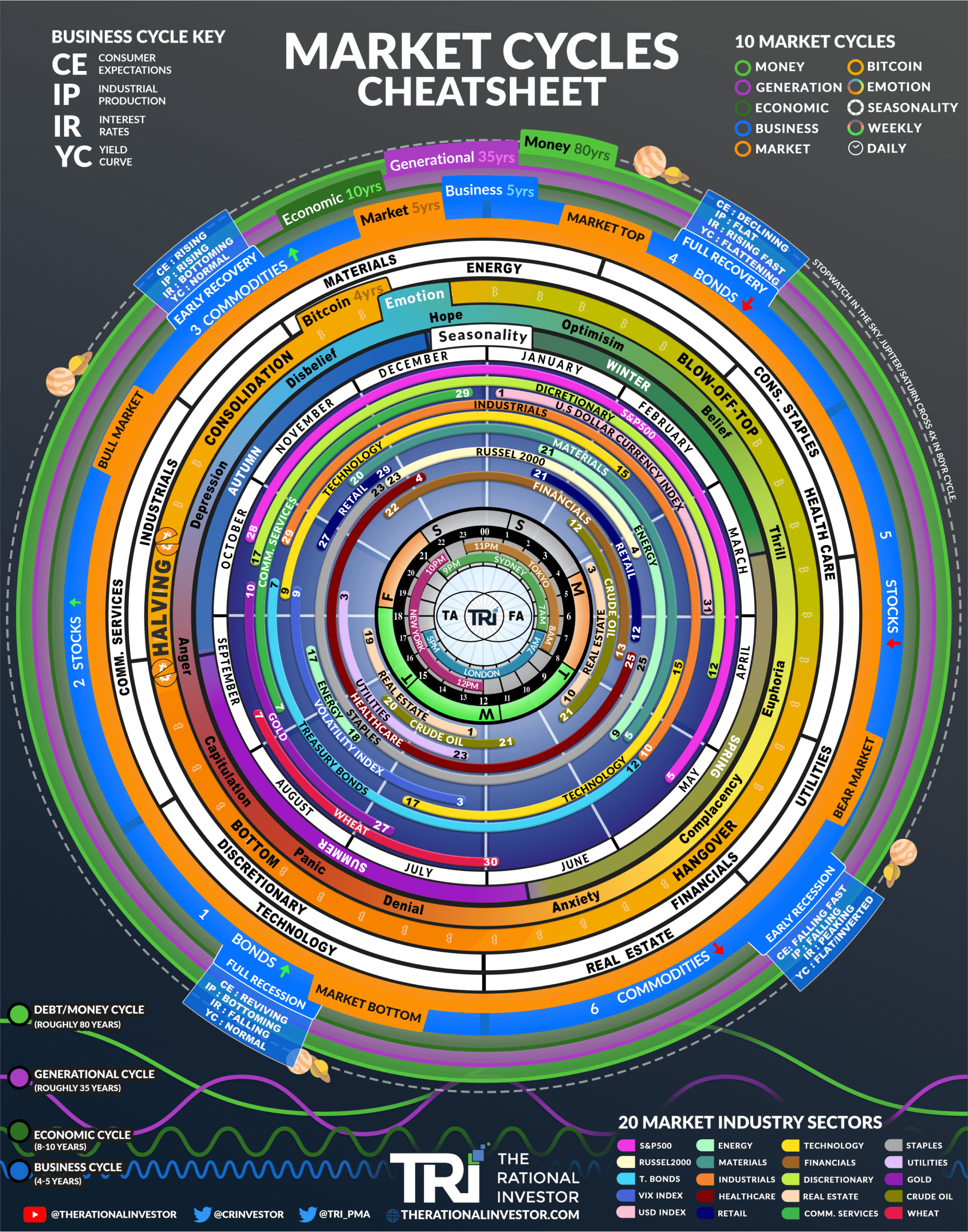
- Learn about broader market cycles that affect crypto: 10 Market Cycles Every Trader Should Know
- Build a trading plan before taking any active trades: How to Make a Trading Plan
This guide is for educational purposes only. Cryptocurrency is a highly volatile asset class. Past performance does not guarantee future results. Never invest money you cannot afford to lose.
Ready to trade with an edge?
Join TRI for daily macro briefs, scanner recaps, and a community of serious traders.